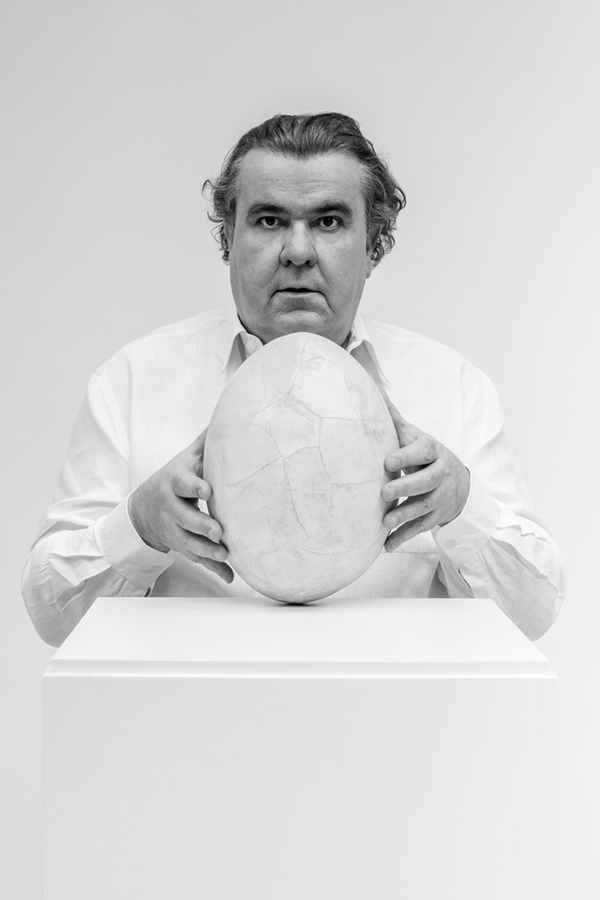
Biographie & Infos
Richard Texier was born in1955 on the French west coast and now lives and works in Paris.
Today he is widely regarded as one of the best living artists of his generation.
He began painting at ta young age and his keen interest in the history of astronomy largely inspired the creation of his own personnel cosmography ;Theoria Sacra is a later excellent example of his passion.
Since 1992 he has created a number of sculpted works, most notably his bronze mythological animals which have contributed to his interpretation of the concept of hybridisation.
His current work is based on the Pantheo Vortex, an artistic exploration of the mystery of the world.
His works are to be found in numerous important public and private collections, both in France and abroad .
Many major museums around the world have exhibited his work including the National museum of Taiwan, the National museum of Luxemburg, the Marine Museum in Paris, the Botanical museum of Brussels, the House of Culture Moscow and the Shangai museum of Fine Art .
Two major themes structure and may be interpreted from his work, those of hybridisation and the mystery of the world.
Hybridisation : Mythological animals
Hybridisation is a salutary quest for humanity.Richard Texier has used this inspiration to imagine a series of mythological beasts.
Since time immemorial great civilisations such as ancient Greece, pre-columbien America, China of the emperors and mysterious Egypt have created mythological animals, half Gods and protectors and inspirers of existence.Today we live a different form of hybridisation, that of ideas, knowledge, territories, peoples and cultures. Richard Texier celebrates this great world movement through a series of works: Bionics, Hybrids and Generis.
A celebration of mistery : Theoria Sacra - Pantheo Vortex
A creative strategy to address the mystery and magical dimension of existence.The western world since the time of Rene Descartes has lived an obsessive objectivity, a drunken rationality and a general denial of all things magical. In the case of Arica Asia and Latin America things however are very different.
Art is the only non dogmatic, non religious means to address such a sensitive subject as the magic of the world and existence.A subject which reveals itself little by little through tentative artistic exploration.
Theoria Sacra: paintings on canvas.
Pantheo Vortex:The result of this exploratory work aims to create a body of photos or more precisely a body of artificially created images offering a vision of enhansed reality through computer processing. Each image shares an identical composition that of a centralised subject suspended in a white light. The images are surrounded by a translucent porcelain like insulating material, a protective sheath or cocoon protecting the image from it's immediate environment.
BIOGRAPHY
1955: Born in France on June 28.
1973-1982: Having begun painting at the age of 12, he is fascinated by the Surrealists’ experiments. He moves to Paris to study architecture. His thesis is titled “Constructions after Nature,” and is close to Land Art. Jean Degottex sits on his jury and later supports him in his work.
Stays in New York, the first of his many sojourns abroad. Makes conceptual works: Relevé de Lune, Lieu bleu, Enregistrement lunaire and the series of Calendriers lunaires, the starting point of his work. They are shown at the FIAC.
The Centre Georges Pompidou commissions three films on the theme
of Artist Propaganda. He sums up the essence of his four years of research
in a visual arts doctorate, Lune, l’autre,
le paysage.
1983-1989: Several exhibitions in New York of the Sentini and Sacro Bosco suites. Moves to the Butte-aux-Cailles quarter
of Paris, where he still works today.
Elaborates a personal cosmography in relation to ancient astronomical plans under the generic title Théoria Sacra.
An exhibition of these pieces tours to four French museums. Pierre Restany and Peter Frank write the catalogue texts.
Travels frequently. Exhibits at the Foundation of the Château de Jau and the Ciento gallery in Barcelona.
1990-1993: Exhibits in Paris (Galerie Bernard-Davignon, Galerie Pierre Levy and Galerie Artcurial), Belgium, and New York. Retrospective at the Musée d’Angers.
Exhibits at the Pavilion of Culture in Moscow for several months and makes a series of 36 paintings presented at the Moscow Center for Contemporary Art and then the Botanique museum in Brussels. Exhibits sculptures at Galerie Pierre Levy.
First exhibition in Japan.
Works in the Manufacture des Œillets where he conceives a suite of
large paintings, Le Continent de l’ange.
1994-1999: Exhibits in Nagoya, Osaka, Tokyo, Taipei.
Major monograph published by Éditions de la Différence.
The National Museum of Taiwan presents 150 works.
Makes a major installation at the Manufacture des Œillets.
Makes a permanent installation for the Médiathèque in Poitiers,
Le centre, le cercle et la périphérie.
Exhibitions at the Reflex gallery in Amsterdam.
Works in the huge Ponant shipyard at La Rochelle, then at Villa Noailles, Hyères.
2000-2004: New bronze sculptures: mythological animals on the theme of hybridization.
Works in the Starett Lehigh building in New York in 2002 then in the Cordouan lighthouse.
Makes huge sculptures and paintings for China. Spends several months in Shanghai.
Exhibits at ARCO in Madrid (Galerie Tessa Herold).
Publication of a monograph by Éditions Flammarion.
Retrospective at the old Criée aux Poissons in La Rochelle.
2005-2010: Exhibition at the Meishuguan (Shanghai Art Museum).
Exhibits at the San Carlo gallery in Milan and at Alisan Fine Art Gallery Hong Kong.
Exhibitions at the M Art Center in Shanghai.
He makes his first film, Rouge très très fort, about Zao Wou-ki (shown on Arte), then two short fiction films about paintings in the Louvre: Gabrielle d’Estrées and The Death of Cleopatra, shown on France 2 TV.
Creation of a mythological animal, the Angel Bear for the Centre National
des Monuments Historiques.
Publication of three portfolios of photographs at Higgins Éditeur.
2011-2014: Renewing his nomadic practice, he lives in Rangoon, Burma.
The paintings he makes there will be shown at the Fondation d’Art Contemporain Bouvet Ladubay .
Publication of a monograph on the sculptures by Éditions du Patrimoine.
Emergence of a new line of work: Pantheo-Vortex, a corpus of images revisiting the animal kingdom, mineral kingdom and life sciences, exploring the mystery and magic of existence.
Shows for the first time his Pantheo-Vortex suite at Galerie Guy Pieters.
Elasto-génèse: installation at Galerie Frémontier, Paris.